
“Oh, bouclé!” How One Word Took Over All Soft Fabrics
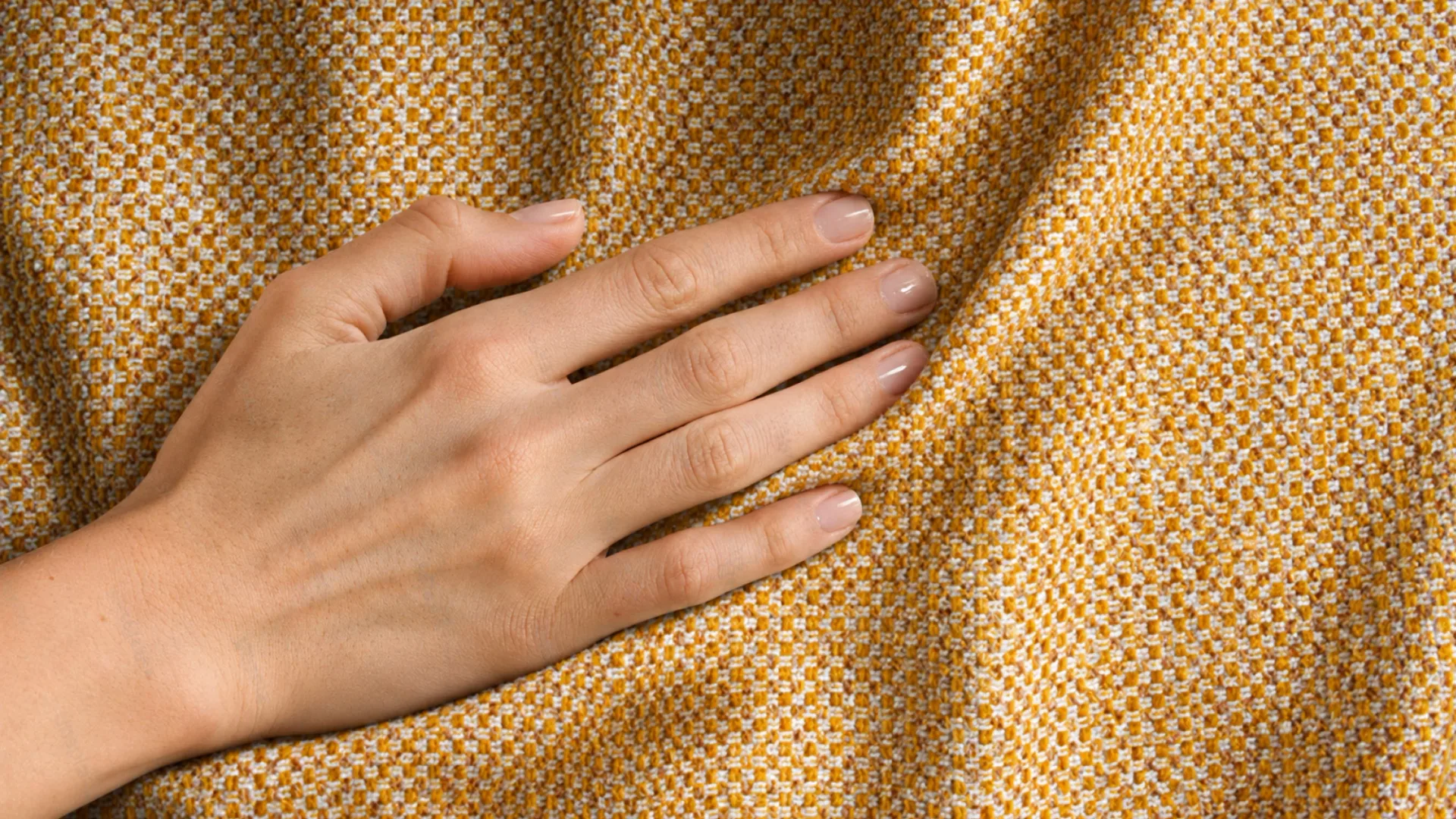
The scene repeats itself so often that we could almost write a script for it. We place a SONORO fabric sample on the table. Someone runs their hand over it, smiles and says, “Oh, bouclé!” We politely but firmly explain that it isn’t. And that’s usually where the most interesting conversation of the entire meeting begins.
That “no” isn’t about being pedantic. These days, a single fashionable word is used to describe an entire family of fabrics that have little in common beyond their softness and visible texture. For the customer, it’s a minor inaccuracy. For manufacturers, retailers and architects, it’s a promise that someone will eventually have to deliver on.
The Rise of a Single Word
For decades, bouclé was a term used mainly within the industry. Weavers, upholsterers and fashion designers knew it well, while customers were more likely to come across it on a jacket label than in a sofa description. In recent seasons, it has made its way into living rooms – quite literally. It appeared in collection names, catalogues, online shop filters and interior design captions, before taking on a life of its own. At some point, it stopped referring to a specific type of fabric and started describing a feeling: something light-coloured, soft, cosy and distinctly textured.
Language is full of examples of this phenomenon. In everyday Polish, almost any pair of trainers might be called “Adidasy”, while disposable nappies are often referred to as “Pampers”. Bouclé has followed much the same path in the furniture industry: almost any textured fabric with a cosy feel has started to be described as bouclé. The difference is that nobody returns a pair of trainers simply because they don’t have three stripes. With a sofa, things can be different.
Loops, Chenille and Weaves
To understand where the confusion comes from, we need to look a little closer – right down to the yarn itself. It is here, rather than on the surface of the finished fabric, that the fundamental characteristics of the fabric are determined.
Bouclé – the name comes from the French verb boucler, meaning “to curl”, and its meaning is surprisingly literal. During yarn twisting, one strand is fed faster than the others, causing the excess length to form small loops. This looped yarn is then woven into a fabric with its characteristic curly surface. The conclusion is simple, yet surprising to many: bouclé refers not merely to appearance, but to construction. Either the loops are present in the yarn or they are not.
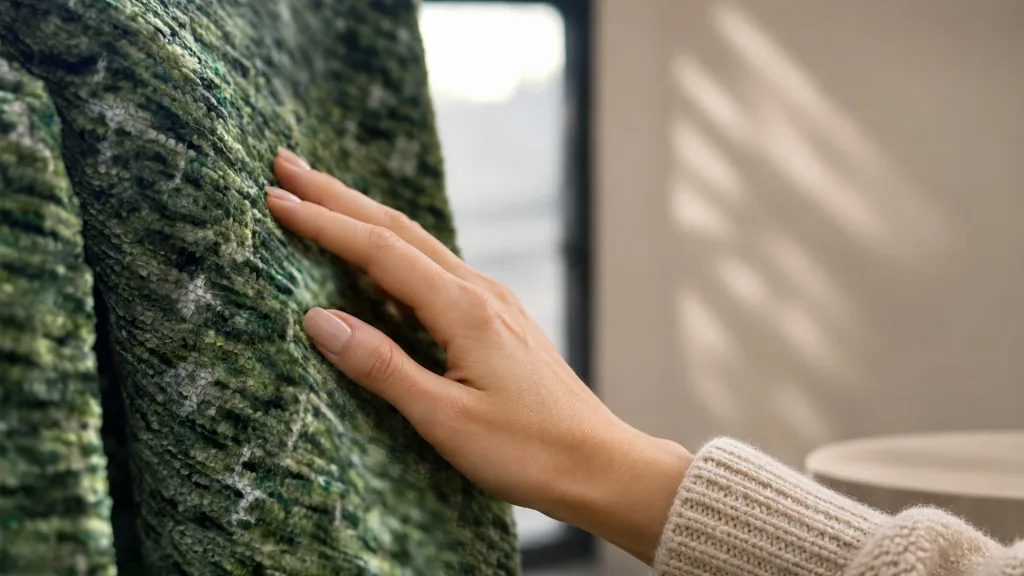
Chenille has an even more picturesque origin. The French word chenille means “caterpillar”, and anyone who has ever examined this yarn under a magnifying glass will understand why. Short, dense fibres project from a fine central core, much like the fuzzy body of a caterpillar. Instead of loops, there is a soft pile, and rather than a matte, curly surface, chenille offers a velvety feel and a subtle sheen that changes with the viewing angle, as the pile reflects light differently from each direction. This is why fabrics made with chenille yarn can appear richer and deeper in colour on a piece of furniture than a sample lying flat on a table might suggest.
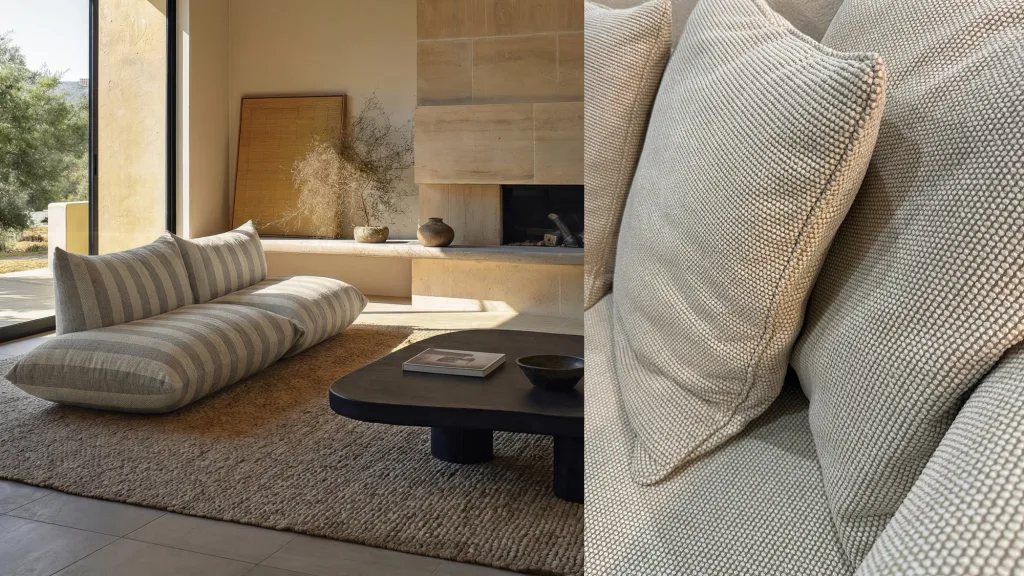
The third family needs neither loops nor pile. In coarse-woven fabrics, the texture comes from the weave itself: thick yarns, variations in yarn thickness and the rhythm of the interlacing warp and weft threads. The result is a surface where the geometry of the weave and the structure of individual yarns are clearly visible, much like a beautifully woven woollen throw.
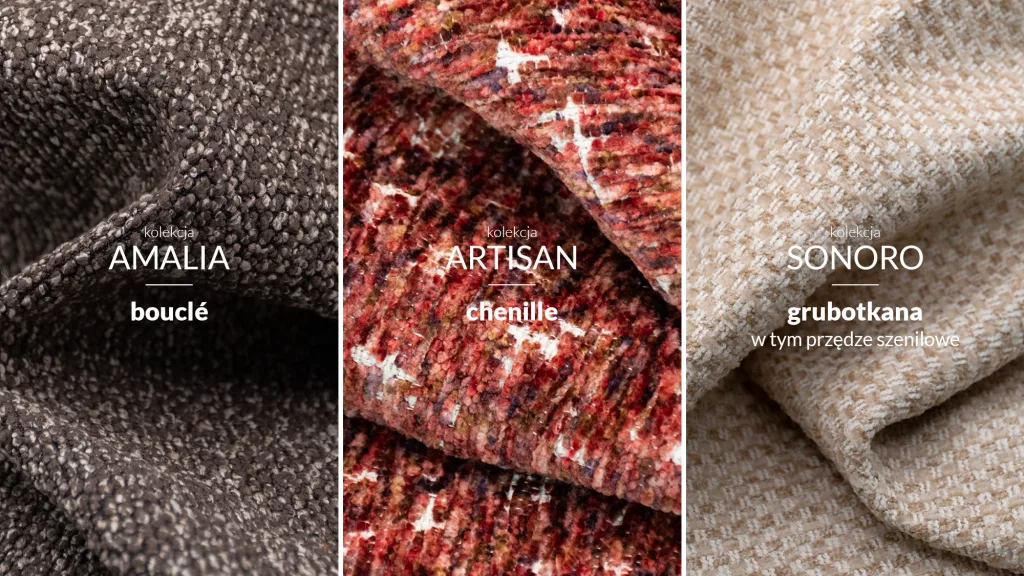
In practice, these categories often overlap. A single fabric may combine yarns of different thicknesses, colours and constructions, including chenille yarns. What determines how the fabric is classified is the element that defines its overall character. If the texture is created primarily by the weave, with chenille playing a supporting role, it is a textured fabric rather than bouclé.
Thirty Seconds, Three Fabric Samples and a Lamp
The best test requires no laboratory. All you need are three fabric samples placed side by side and thirty seconds of attention.
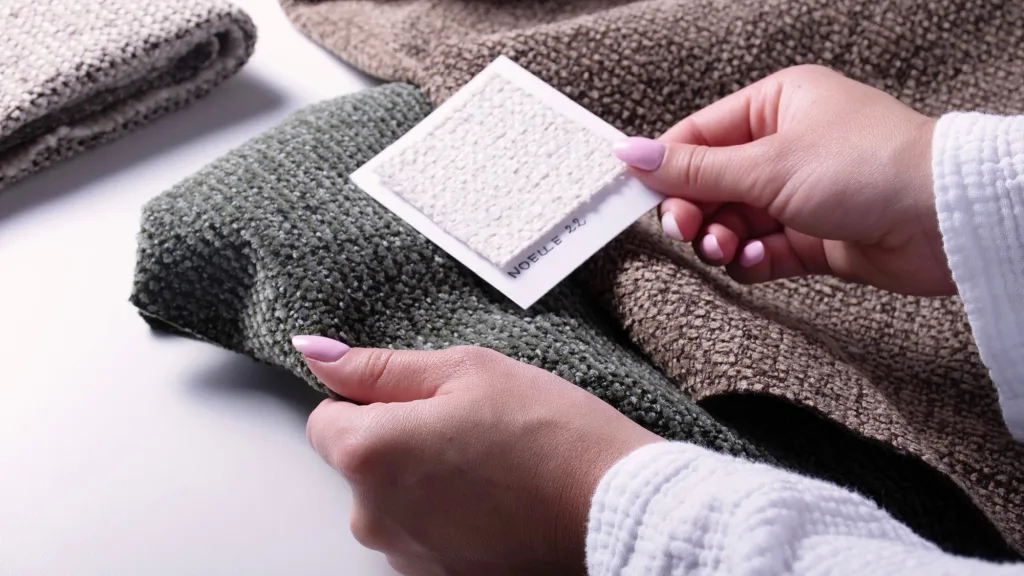
First, look at the samples from arm’s length. Loops are immediately visible, even the smallest ones. Chenille reveals itself through a sheen that moves across the surface as you gently tilt the sample. In a coarse-woven fabric, what stands out most is the weave pattern, whether regular or deliberately irregular.
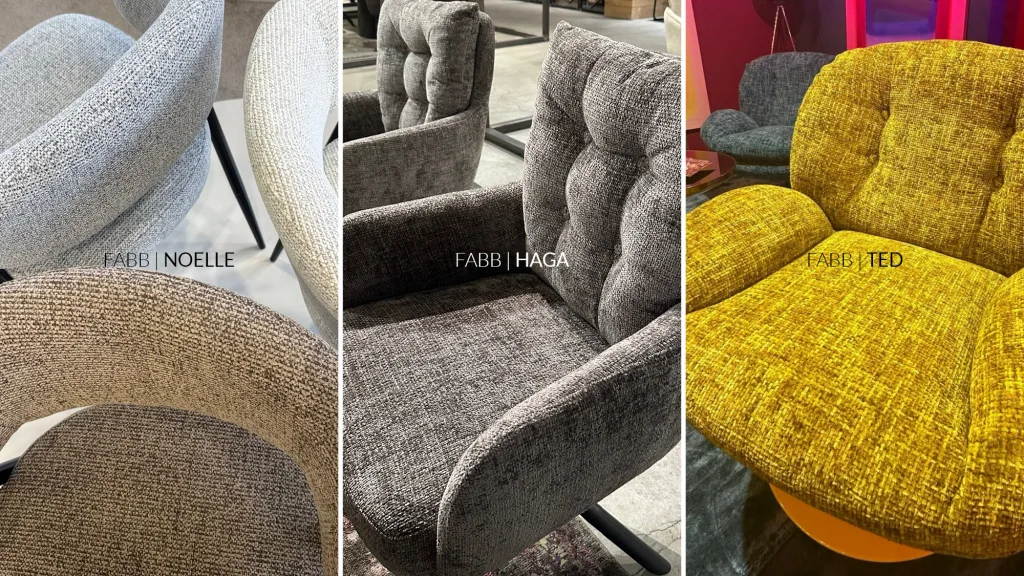
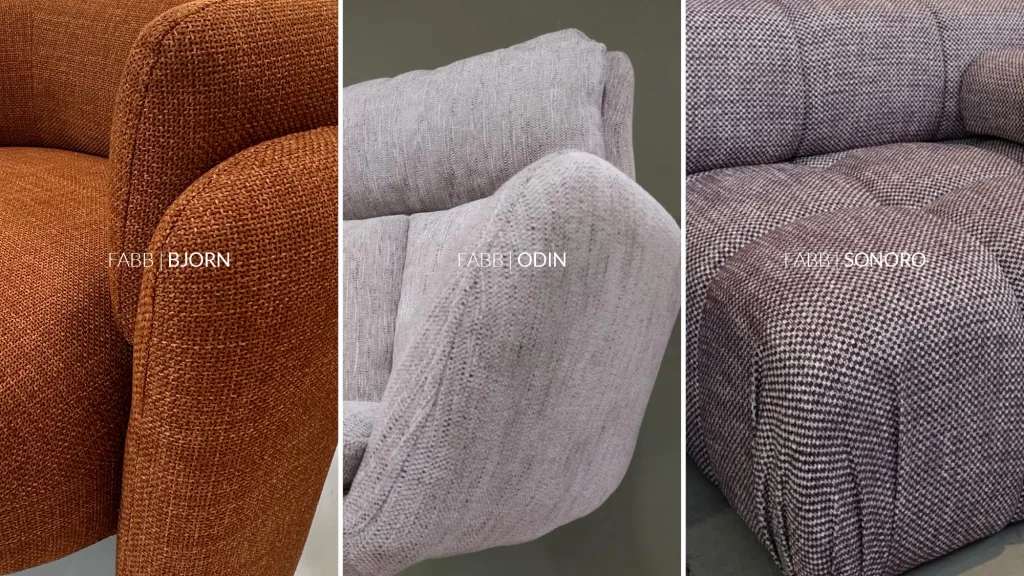
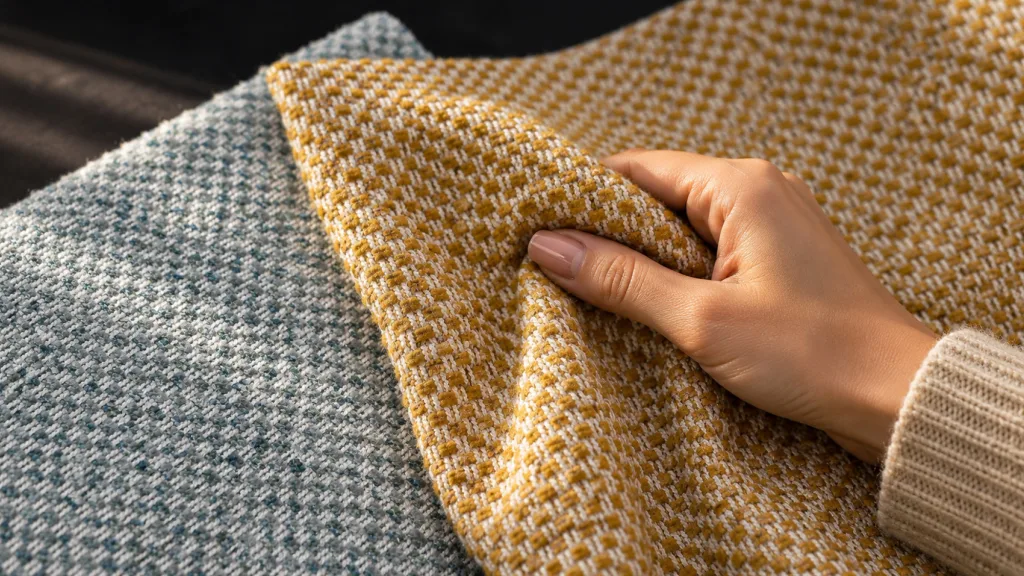
Next, use your hand. Bouclé offers a slight, springy resistance, as though there were countless tiny springs beneath your fingertips. Chenille feels noticeably smoother in one direction than the other, much like animal fur. A woven texture reveals itself through a regular, tactile relief.
Finally, there’s light – and this reveals the most. All you need is a lamp positioned to one side or a window to the right of the table. On a smooth surface, side lighting makes little difference. On a coarse-woven fabric, it brings out a rhythm of tiny shadows that looks like a map up close but, from two metres away, blends into a calm, multi-tonal surface. It’s worth trying this test together with a customer. After such a demonstration, the name of the fabric usually stops being a point of debate.
The Cost of a Borrowed Name
The temptation is understandable. Customers search for “bouclé sofas”, filter products using trending keywords, and labelling every textured fabric as bouclé can temporarily boost visibility in an online shop. But the cost comes later, and it isn’t the marketing department that has to deal with it.
Instead, it falls on the customer service team, who have to explain why a “bouclé sofa” looks different from the inspirational images the customer has saved. It falls on the returns department. And on the sales representative, who has to start the next conversation with that same customer by rebuilding trust. In projects involving interior designers and architects, the cost can be even higher. An imprecise fabric description in a specification can easily lead to disputes at the final inspection stage, when no one has time left to debate terminology.
The paradox is that a customer who saw the same piece of furniture upholstered in a well-chosen textured fabric, without any label attached to it, would often be perfectly happy with it. The disappointment comes not from the fabric itself, but from the mismatch between what the name promises and how the fabric actually feels.
The solution is simple, although it requires discipline: describe what you can actually see and feel. Textured fabric, coarse-woven fabric, yarn-dyed fabric, fabric incorporating chenille yarns. It may sound less catchy than a single fashionable term, but it makes no promises it cannot keep. It also provides better answers to the increasingly detailed and specific questions people now type into search engines and ask AI assistants.
The Case of SONORO
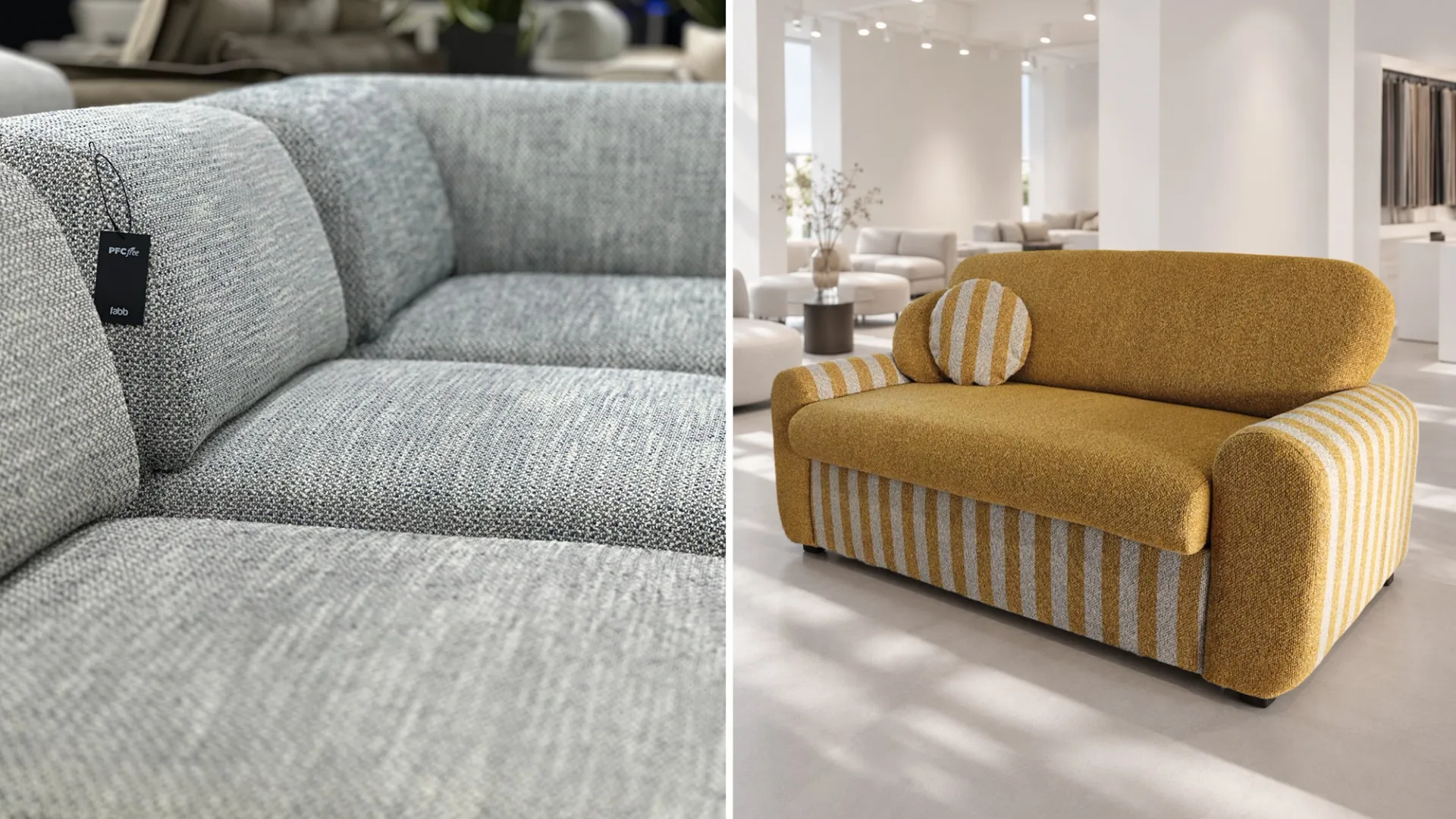
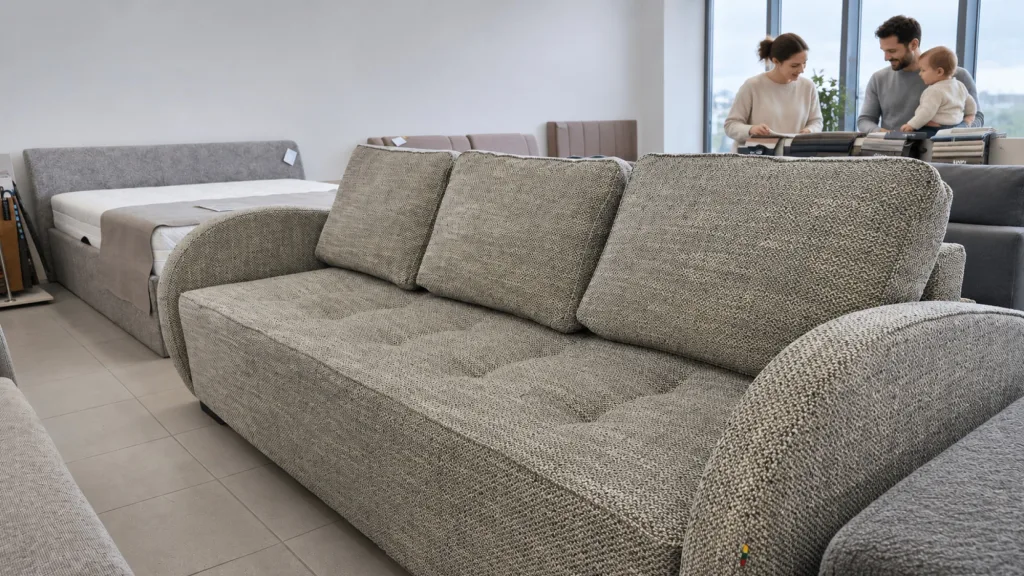
SONORO is exactly the kind of fabric that most often prompts the reaction, “Oh, bouclé!” We understand where the association comes from. The first impression is similar: a soft, richly textured, multi-tonal surface that invites you to touch it.
Up close, however, the difference is clear. SONORO contains no looped yarn. Its surface is created by a woven construction using thicker, differently coloured yarns, including chenille. The fabric has a distinctly woven, almost grainy texture, with the structure of each individual yarn clearly visible. The chenille does not give it a furry appearance; instead, it adds fullness and softness to the touch. From two metres away, the individual details blend together, leaving a calm rhythm of complementary tones.
We could take the easy route and add SONORO to the long list of “bouclé fabrics”. But we deliberately choose not to. The market does not need another fabric pretending to be something it is not. It needs fabrics with a character of their own, capable of standing on their own merits when upholstered on furniture, even when a customer walks into a showroom with the product description in hand. You can read more about the collection on our SONORO page.
Once You Know What’s on the Table
Using the correct terminology has another, less frequently discussed advantage: it makes combining fabrics easier. When we know whether we’re dealing with loops, pile or a woven texture, it becomes easier to predict how one fabric will work alongside another.
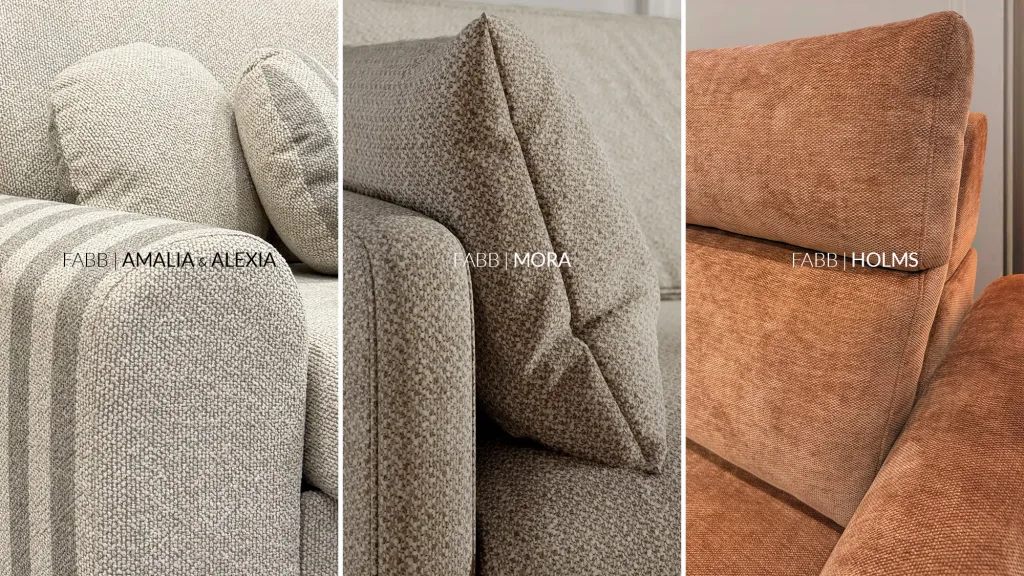
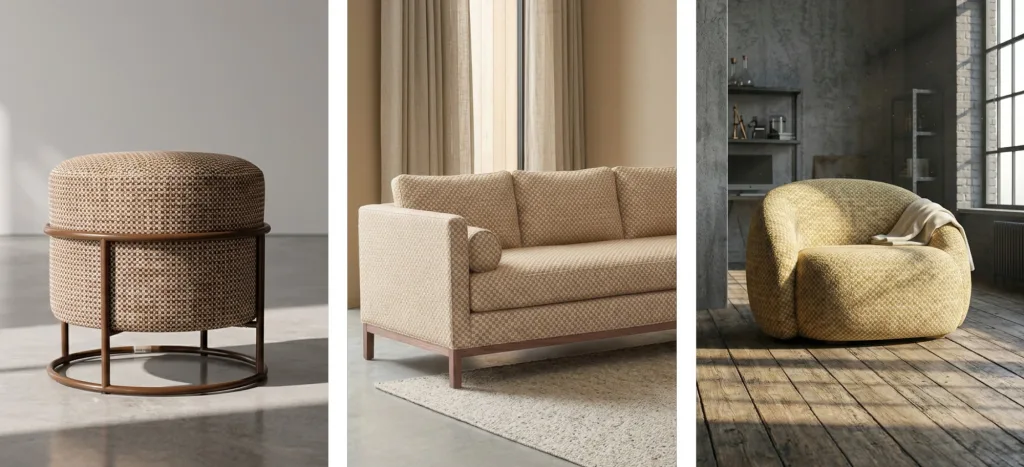
The principle that works best in most cases is simple: let one texture take the lead while the others play supporting roles. A textured fabric is a natural choice for the leading role because it stands out most clearly in a combination. It can cover the main body of a sofa, with smoother fabrics on the cushions and sides creating a more balanced look. Alternatively, it can take a supporting position as an armchair or pouffe alongside a smooth-upholstered sofa, acting as an accent. Paired with velvet in the same colour palette, it creates a contrast between matte texture and subtle sheen. Combined with a longer-pile fabric, it produces a layered, tactile composition, ideal for interiors where furniture is designed to invite touch.
The most common mistake is placing two bold textures of a similar scale right next to each other. Instead of complementing one another, they compete for attention. A coarse texture works better alongside something finer or smoother, while a bold colour is best balanced with a more muted tone.
This is clearly illustrated by the colour palettes we have created for SONORO. Stone-grey SONORO 05 paired with HOGAN 07, HOGAN 04, BLUVEL 03 and QUINN 02 creates a combination in which the colours are almost identical, leaving the textures to do all the work. It is hard to find a better example of how neutral does not have to mean flat. Caramel-toned SONORO 30 combined with BUBBLE 44 and LAPIT 44 takes the same principle in the opposite direction, towards rust and copper, creating a combination that catches the eye in a showroom. All seven colour combinations, complete with fabric codes, can be found on our SONORO Mix & Match
And the next time someone at the fabric sample table says, “Oh, bouclé!”, rather than correcting them, try moving a lamp closer and tilting the sample towards the light. Conversations about fabric become much more interesting when they start with the yarn.
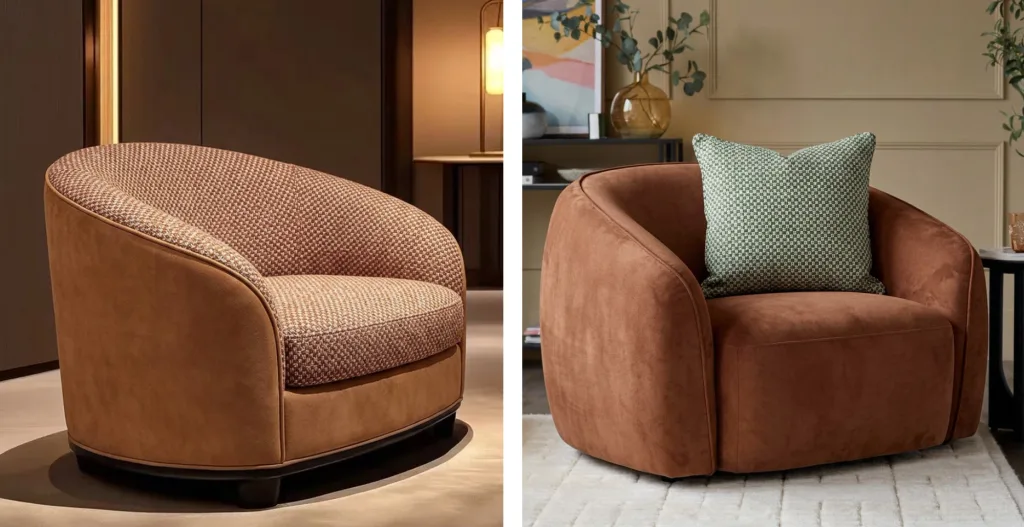
Bouclé, chenille or a coarse weave? The easiest way to see the difference is in person.
Explore SONORO, discover our Mix & Match combinations and order a hanger to take a closer look at the texture, colour and yarn structure.
Explore our other collections: