
CIFF 2026: Is China Becoming the World’s Next Design Trendsetter?
What has happened in China over the past decade is difficult to compare to any other technological leap in modern history. From OEM production – often based on European designs and perceived as a “cheaper alternative” – China has evolved into a technological and industrial superpower, dominating key global supply chains.

Since the launch of the Made in China 2025 strategy in 2015, the focus has shifted toward proprietary production, innovation, artificial intelligence, and a new standard of quality. As a result, the global center of gravity – not only in trade and economics, but also in technology—is steadily moving from the Atlantic toward the Pacific.

This shift is clearly reflected in the March trade fair in Guangzhou, which has become a key annual checkpoint for the interiors industry. Its unique format – combining home furniture, contract interiors, and production technologies – offers a rare, holistic view of the entire sector. It allows us to track how ideas move from concept to mass production and how they are ultimately absorbed by the market.
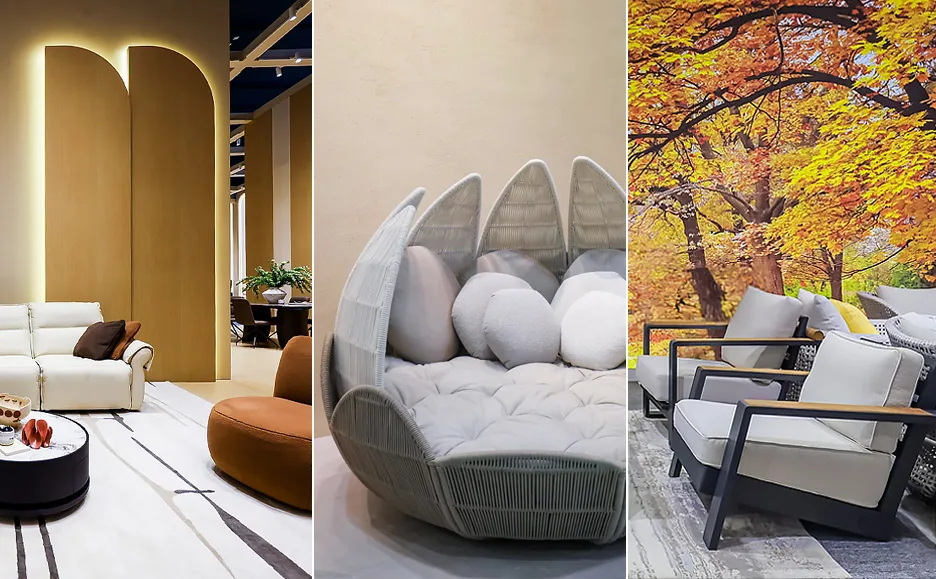
Guangzhou is redefining what we understand as a “trade fair.” We are talking about an 850,000 m² exhibition space – essentially a full-scale “trade city” equivalent to 150 football fields – bringing together over 5,000 brands from more than 200 countries. While Salone del Mobile continues to set the tone for luxury, curated design, CIFF defines the standards for the global mass market: smart technologies, scalable production, sustainable materials, and personalization.

From “Made in China” to “Designed in China”

CIFF’s exhibition programs openly declare this ambition. The Design Export section showcased original Chinese brands as a new wave building both cultural and commercial value on global markets. The presence of international brands such as Vitra, Gubi, and Memphis alongside Chinese studios signals a clear shift – from imitation to dialogue and co-creation.

CIFF 2026: The Asian Counterpart to Salone – But on Its Own Terms

Salone del Mobile remains an icon – a temple of luxury and curated design, where narratives around lifestyle and emotional value are shaped. However, for the B2B sector, CIFF clearly leads with its full supply chain model, bringing together three pillars – Home Furniture, Office & Commercial Space, and Manufacturing & Materials – in one place and time.
This means innovation is not limited to aesthetics (form, color, detail), but is often embedded in materials, fittings, and production technologies – where real competitive advantage is built: cost efficiency, quality, environmental footprint, and speed to market.

Large-scale furniture fairs are no longer the sole centers of gravity. Brands increasingly shift attention to city-based events, showrooms, and hybrid formats. In this context, CIFF is growing as an industrial, commercial, and technological platform, while Salone remains a powerful trend driver – focused on culture, storytelling, and prestige – even as it adapts its own format.
Three Keywords Defining CIFF 2026: Smart, Sustainable, Cross-Disciplinary

This year’s edition highlighted three core ideas shaping contemporary furniture design: smart furniture, sustainable materials, and cross-disciplinary design.
China is rapidly becoming one of the key drivers of innovation in smart furniture, personalization, and eco-conscious solutions. Integrated smart home systems, USB charging, induction surfaces, LED lighting, motion sensors, and Bluetooth audio have become standard – combined with strong aesthetic direction (Japandi, quiet luxury, retro, industrial) and compliance with environmental standards such as FSC, low-VOC, and REACH.

In the Smart Ecosystem zone, products like the DSleep Auto3Pro bed and Sleepone AI Mattress 3.0 demonstrated real-time adaptability—adjusting support and firmness based on body position, pressure distribution, and sleep analysis powered by AI. Responsive sofas, dining tables with invisible induction charging, and office chairs that analyze posture and self-adjust settings all pointed in the same direction.
The key, however, was invisibility. Technology was seamlessly integrated into clean, refined design—furniture looked like furniture, not like gadgets. What remained visible was comfort and personalization.

Interestingly, CIFF also showcased digital innovation in the user experience of the fair itself – AI assistants and interactive navigation systems supporting movement across the vast exhibition space. A small detail, but a telling one: it reflects how deeply digitalization is embedded as a tool for scaling both commerce and spatial experience.
The Home as a System: Modularity and Personalization

A strong trend at CIFF 2026 is the idea of the home as a system – one that can be “programmed” to adapt to changing needs. This directly connects to segments shaped by demographic shifts and evolving lifestyles: Healthy Aging, Pet Home, Massage Chairs / Functional Sofas, and New Retail (health, care, wellbeing, human–animal relationships, and hybrid home–work living).

Age-inclusive design and the “silver economy” are no longer treated as single-product categories, but as fully integrated ecosystems. Healthy Elderly Living combines power-assisted furniture, care technologies, and service systems—responding to the realities of aging societies.
- Pet-friendly design is becoming the new mainstream. Pet Home & Supplies was presented as a distinct and rapidly growing category—combining furniture, smart devices, and accessories. Furniture is now designed from the ground up to be shared by both people and pets, taking into account animal behavior, safety needs, and ease of maintenance.
- Modularity is another key direction – sofas, tables, and storage systems designed for easy reconfiguration, especially in small to mid-sized living spaces where flexibility is essential due to rising housing costs.
- Outdoor is no longer treated as a separate category, but as a natural extension of interior design language. The special exhibition “Nature’s Echo” explored how to recreate a “tactile, breathing” natural environment within the city. It reflects a broader shift: outdoor living is now designed with the same attention to material storytelling and atmosphere as the living room.
What we see today in Guangzhou is no longer an attempt to catch up with Europe. It is a parallel ecosystem—developing faster, more technologically, and with a clear emphasis on scale.
If Milan still tells us how we want to live, CIFF increasingly shows how it will be produced.
„DARE TO BE… in CHINA” where the future is made

This is where a second, less obvious layer of the fair begins. Behind smart furniture, modularity, and new lifestyle scenarios lies something even more fundamental: materials, textile technologies, and an industrial ecosystem that is now largely concentrated in China.

In the next part, we’ll take a closer look at this from the perspective of upholstery fabrics—their role in design and their real production potential.
This is also where our own story comes in. FABB, present at CIFF through its Chinese branch, operates precisely at this intersection—where design, technology, and responsible production meet.
Because today, “Dare to be…” is not just about aesthetics. It’s about the courage to make technological and environmental decisions—where real quality begins.

Photos: https://ciff-gz.com/en/gallery